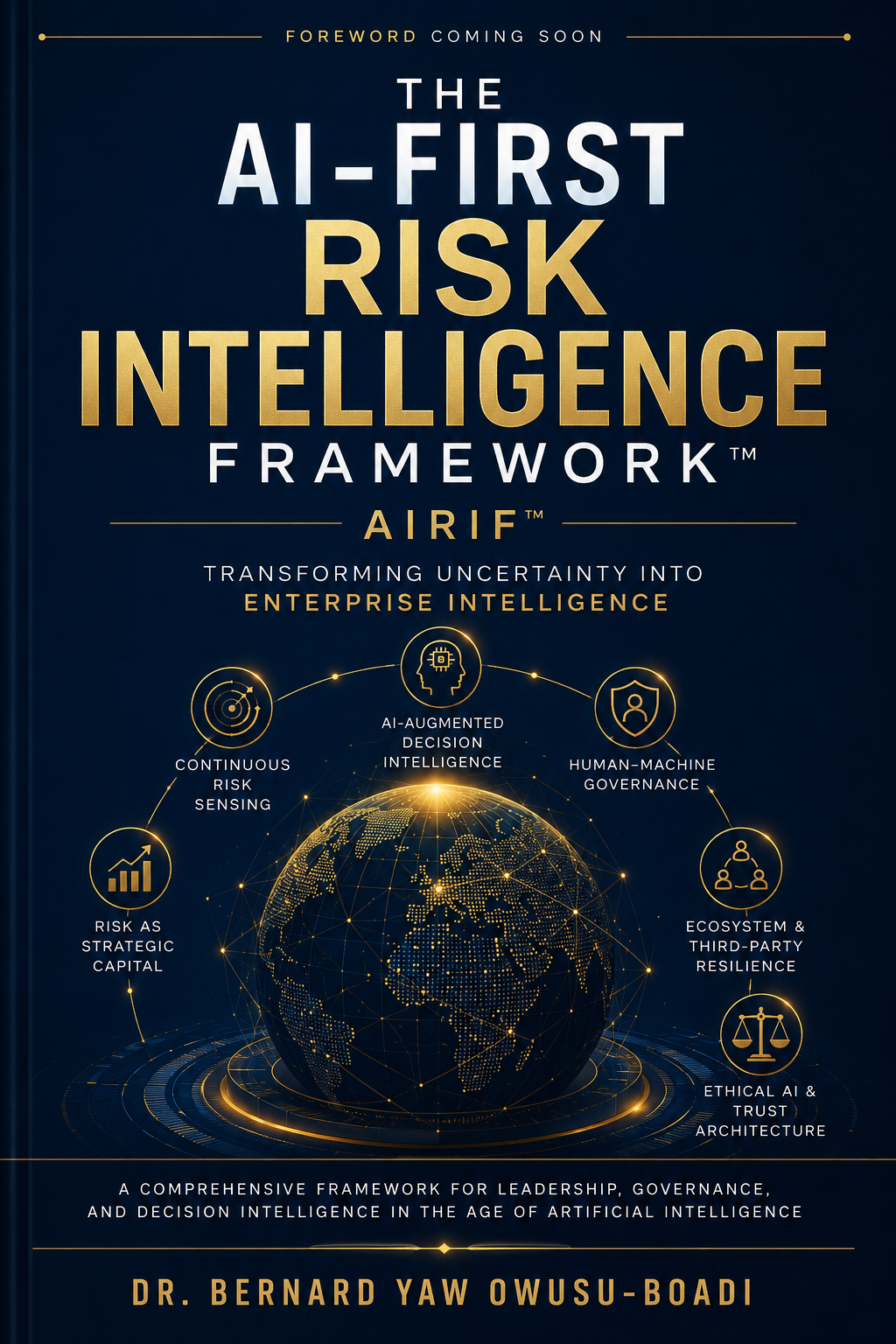
The AI-First Risk Intelligence Framework (AIRIF) book cover by Dr. Bernard Yaw Owusu-Boadi
Books · Forthcoming

The AI-First Risk Intelligence Framework

AIRIF™

An enterprise operating architecture for integrating leadership, governance, artificial intelligence, enterprise intelligence, decision-making, resilience, and organizational learning into one cohesive system.

Forthcoming · 2026
The Central Proposition

Transform uncertainty into intelligence.

AIRIF begins from a fundamental shift in the enterprise environment: risk is continuous, decision cycles are accelerating, artificial intelligence is reshaping operations, and organizations possess more information than leaders can reasonably interpret.

Organizations create sustainable competitive advantage not by eliminating uncertainty, but by transforming uncertainty into intelligence that improves every significant decision.

AIRIF does not seek to replace established governance disciplines. It extends them into the age of artificial intelligence by integrating continuous intelligence, AI-assisted decision support, enterprise-wide integration, ethical governance, predictive capability, and adaptive operational resilience.

The AIRIF Model

Six integrated pillars

01

Continuous Risk Sensing

Detect and interpret emerging internal and external signals before they become significant organizational threats.

02

Risk as Strategic Capital

Convert uncertainty from a defensive concern into intelligence that informs strategy, opportunity, and enterprise value.

03

AI-Augmented Decision Intelligence

Use artificial intelligence to strengthen analysis, prediction, recommendations, and executive situational awareness.

04

Human-Machine Governance

Establish clear accountability for AI-assisted decisions while preserving human responsibility for final decisions.

05

Ecosystem & Third-Party Resilience

Extend enterprise intelligence and governance across suppliers, partners, platforms, contractors, and other dependencies.

06

Ethical AI & Trust Architecture

Design transparency, fairness, explainability, accountability, reliability, security, and human-centered governance into intelligent systems.

Who the Book Is For

Leadership for the intelligent enterprise.

Executive leaders
Leading organizations through accelerating complexity and AI-enabled transformation.
Boards of directors
Governing intelligent enterprises while preserving accountability and public trust.
Government agencies
Advancing AI governance, enterprise modernization, and institutional capability.
Researchers and academics
Examining the future of enterprise leadership, governance, and organizational intelligence.
Students and future leaders
Preparing for leadership in an era where technology expands capability but accountability remains human.
Beyond a Risk Framework

An enterprise operating philosophy.

Governance enables innovation.

AIRIF treats governance as the architecture that makes responsible innovation sustainable rather than as a constraint on technological progress.

AI strengthens leadership.

Artificial intelligence augments analysis and judgment; it does not replace executive accountability.

Learning creates resilience.

Organizational maturity is adaptive. Enterprises strengthen by continuously learning from decisions, operations, signals, and outcomes.

Trust creates enterprise value.

Ethics, transparency, accountability, security, and stakeholder confidence are treated as strategic enterprise capabilities.

Publication Status

Forthcoming.

The full AIRIF manuscript, proprietary assessment instruments, implementation toolkit, reference architectures, maturity methodology, and detailed implementation assets are not being released through this preview.

This page introduces the book's governing proposition and high-level architecture while the manuscript proceeds toward publication. Final cover, publisher, ISBN, release information, and authorized publication links will be added when available.