The
Intelligent
Enterprise
Review
Executive thinking for leaders responsible for governing intelligence, preserving institutional coherence, and building enterprises designed to endure.
NOW PUBLISHED · AIRIF™: AI-First Risk Intelligence Framework · Paperback & Hardcover on Amazon
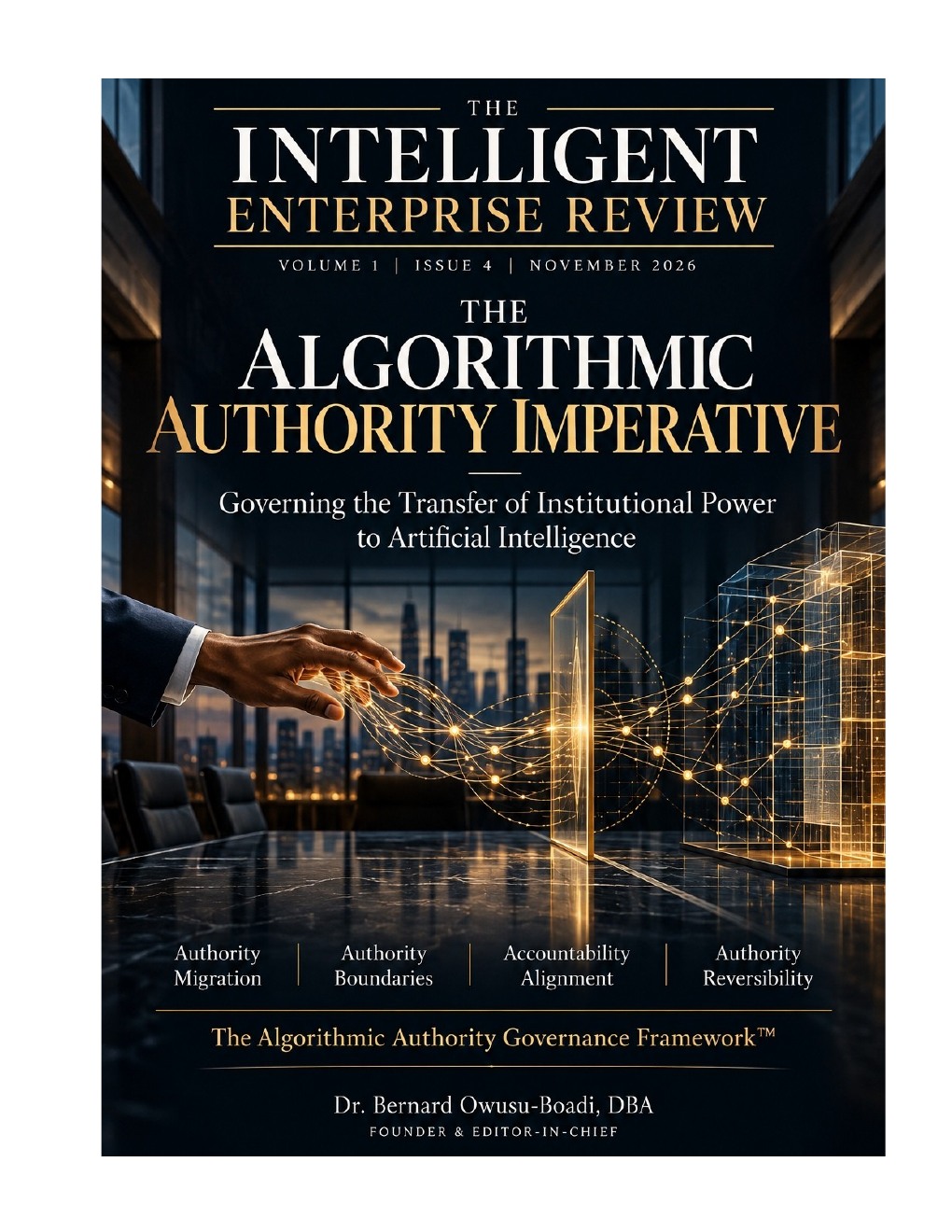
The Algorithmic Authority Imperative
Governing the Transfer of Institutional Power to Artificial Intelligence
Volume 1, Issue 4 examines where institutional authority resides when artificial intelligence materially shapes organizational outcomes. It distinguishes formal authority from functional authority and develops Authority Migration to describe the movement of substantive institutional influence or decision power toward technological systems.
The issue introduces the Algorithmic Authority Doctrine™ and Algorithmic Authority Governance Framework™, organized around Authority Visibility, Authority Boundaries, Decision Rights, Challenge Capacity, Accountability Alignment, and Authority Reversibility.
The Judgment Sovereignty Imperative
Preserving Human Judgment in the Age of Algorithmic Influence
Volume 1, Issue 3 examines whether institutions retain the independent human and organizational capacity required to exercise consequential judgment as artificial intelligence increasingly shapes information, alternatives, recommendations, and reasoning.
The Decision Sovereignty Imperative
Who Should Decide in the Age of Artificial Intelligence?
Volume 1, Issue 2 examines legitimate institutional decision authority as artificial intelligence increasingly informs, recommends, optimizes, and executes consequential enterprise decisions.
An architecture for institutional durability.
The inaugural issue centers on the proposition that enduring institutions require more than successful leadership outcomes. They require governance architecture, disciplined decision rights, leadership systems, operational coherence, and the capacity to learn and adapt without surrendering institutional responsibility.
The five disciplines below provide the organizing architecture for the Review’s continuing examination of intelligent enterprises.
Explore the Five DisciplinesA publication for institutional responsibility.
The Intelligent Enterprise Review is an executive publication focused on the architecture of durable institutions in an era of accelerating intelligence.
It is written for boards, chief executives, operating leaders, governance professionals, public-sector executives, and scholars responsible for aligning innovation with accountability, legitimacy, and long-term institutional performance.
Five disciplines of the intelligent enterprise.
Governance Architecture
Decision Sovereignty
Leadership Systems
Operational Discipline
Adaptive Learning
Governance Architecture
The structures through which authority, accountability, oversight, and institutional responsibility are made operational. In the intelligent enterprise, governance is not an afterthought to automation; it establishes the conditions under which intelligence may be deployed responsibly.
Decision Sovereignty
The preservation of clear institutional authority over consequential decisions. As intelligent systems participate in analysis and execution, organizations must remain explicit about who possesses decision rights, where judgment resides, and how accountability is retained.
Leadership Systems
Leadership understood as institutional capacity rather than individual presence. Durable enterprises translate leadership intent into systems, routines, standards, succession capacity, and decision disciplines that can persist beyond a particular executive tenure.
Operational Discipline
The conversion of strategy and governance into repeatable execution. Intelligent transformation becomes durable when operating models, controls, responsibilities, performance mechanisms, and escalation paths reinforce rather than undermine institutional intent.
Adaptive Learning
The institutional capacity to absorb evidence, revise assumptions, and adapt without losing coherence. Learning becomes a governance capability when organizations can evolve their systems while preserving accountability, legitimacy, and strategic purpose.
Dr. Bernard Owusu-Boadi
Chief Operating Officer · AI Governance Strategist · Strategic Leadership Scholar
Dr. Bernard Owusu-Boadi works at the intersection of strategic leadership, enterprise governance, AI governance, risk, and institutional performance.
Through The Intelligent Enterprise Review, he advances executive frameworks and governance ideas designed to help leaders build institutions that remain accountable, resilient, and coherent as technology and complexity accelerate.
Editorial Correspondence
For editorial inquiries, executive dialogue, speaking, and publication correspondence: